
Why don’t your family and your pets have a safe room?
A finished basement or a pretty kitchen does not give you a place to go when the river is in the street, or when nobody is answering 911. Kitchen GC builds two different things. One is a storm safe room, designed against wind and debris the way FEMA describes it. The other is home fortification: walls, glass, doors, ventilation, and concealed storage when the threat is people, fire, or a loss of police response.
Open the one that matches your house. Both end the same way. We come to the house, a special-operations veteran walks the threat with you, and you get a written report. We do not show your systems, your construction, or your features to anyone. Building inspectors review the plans that the code requires. The function, the location, and the construction details are not made public. When you hire us you get our non-disclosure agreement and our records storage policy.
Current as of October 3, 2026. Storm criteria below are summarized from FEMA publications. Kitchen GC is not FEMA, does not certify safe rooms or products, and is not responsible for how you use this page. Read the documents yourself. Fortification and firearm storage are not legal advice. Before you rely on a storage or access design, consult a Massachusetts criminal defense attorney.
Discussion renderings only
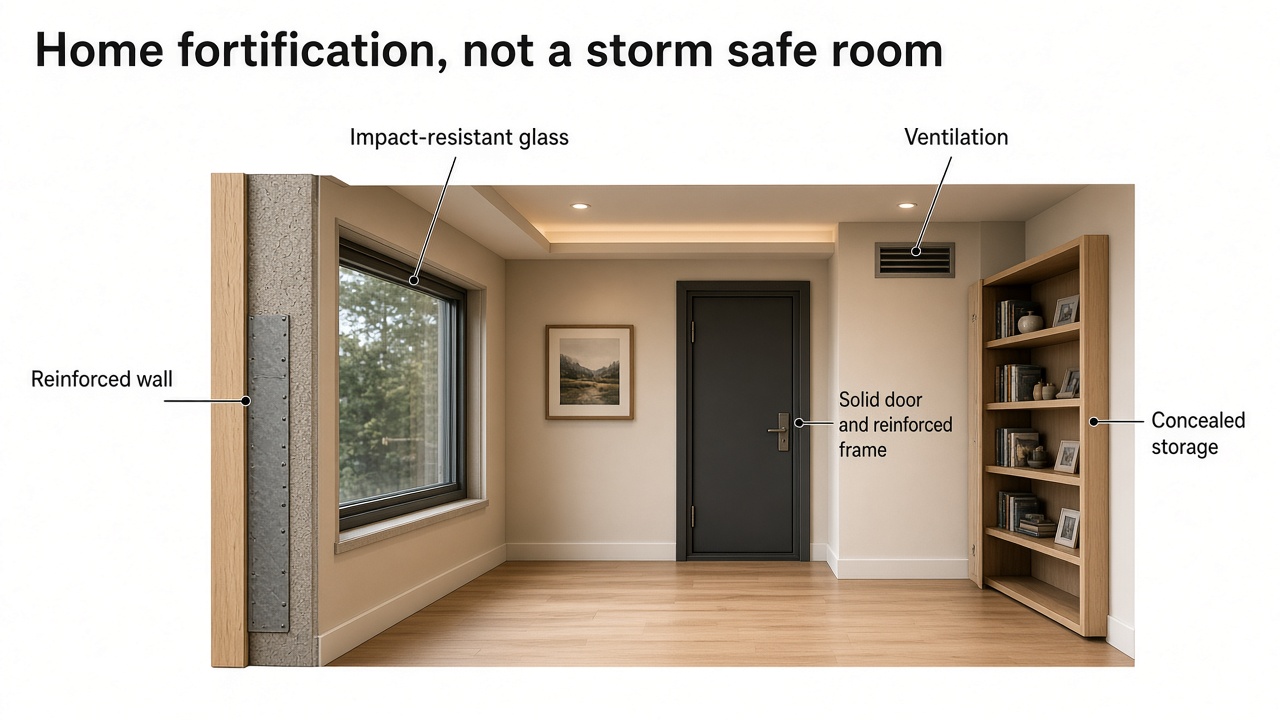
These drawings are only renderings for discussion. We do not publish our proprietary methods or plans. They are not construction documents, not a specification, and not a promise of how your room will be built.
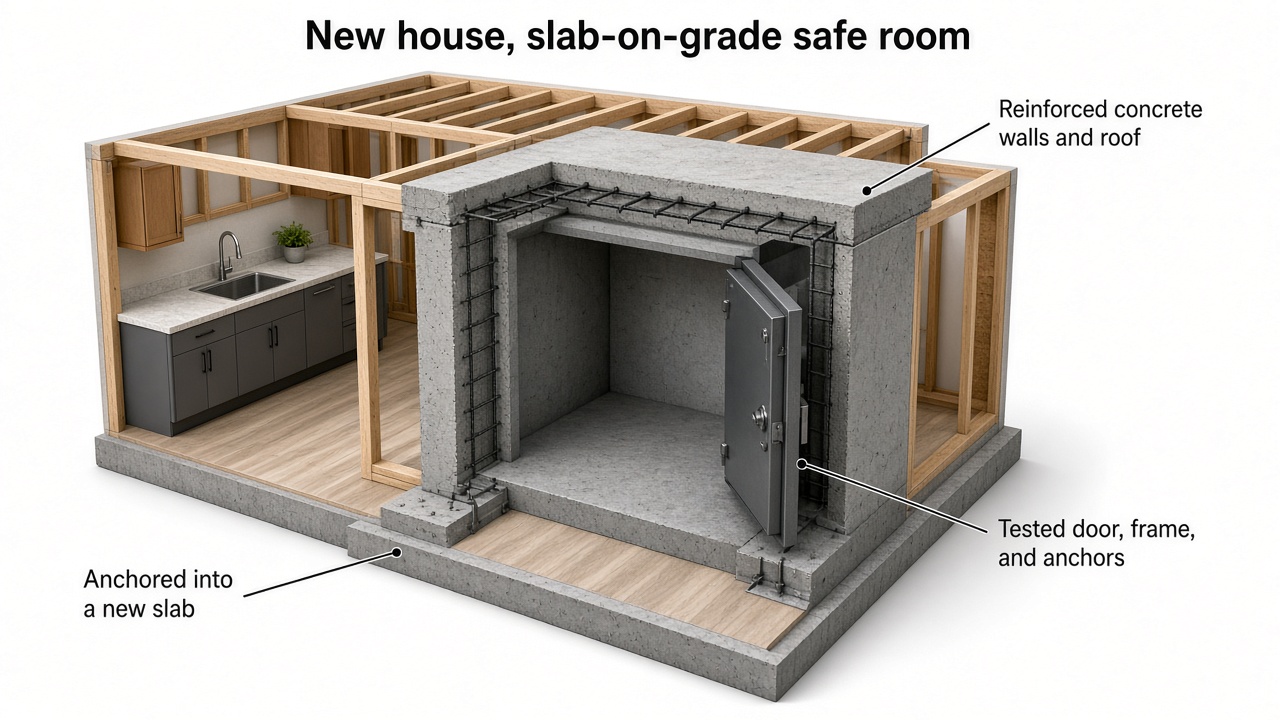
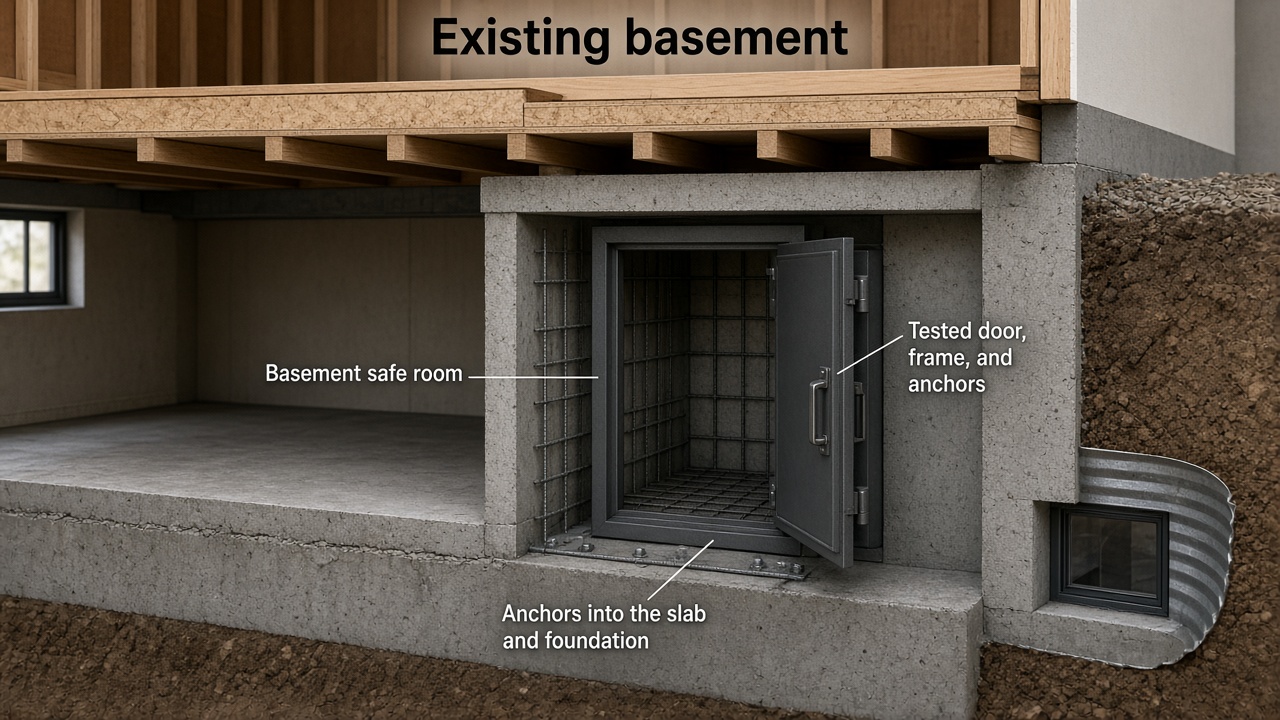
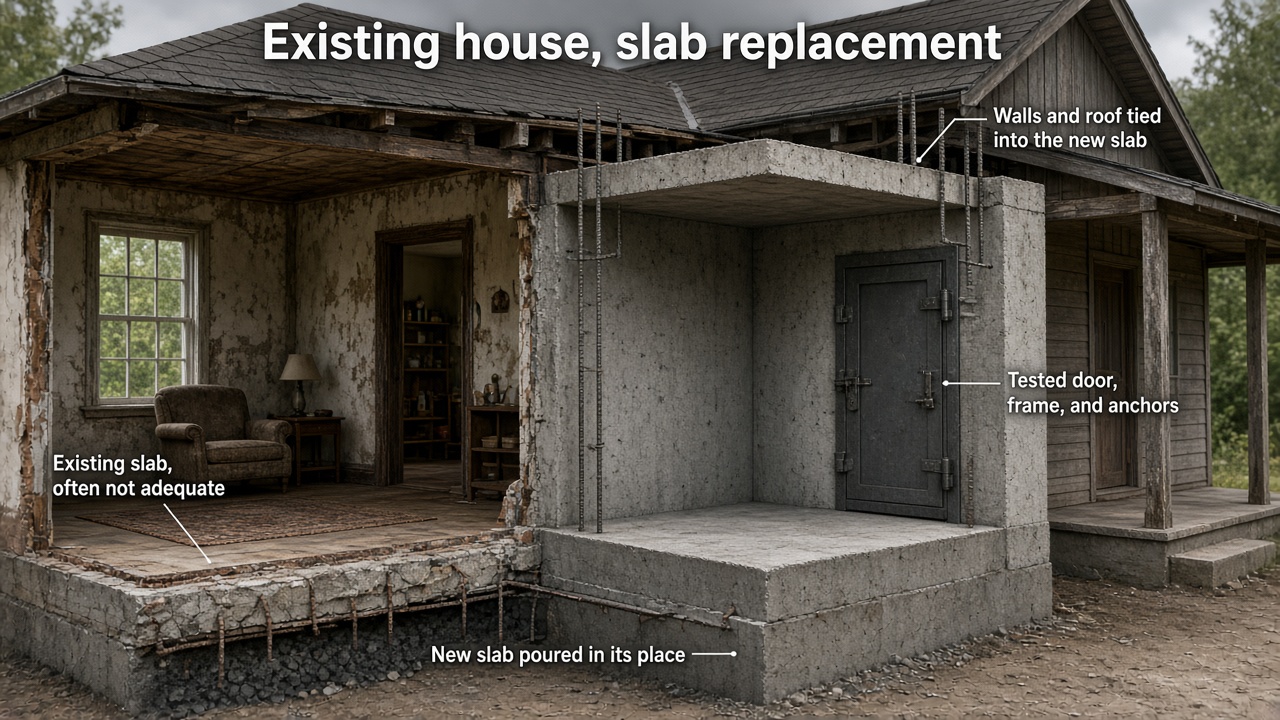
Storm safe room. Hurricanes, tornadoes, coastal storms, river and lake flooding.
Massachusetts has already had the storms people treat as someone else’s problem. These are events federal and National Weather Service records actually document. They are not a complete history.
- April 15–17, 2007 coastal storm. Wind, river flooding, and coastal flood damage, including Salisbury. FEMA declared DR-1701 for severe storms and inland and coastal flooding.
- March–April 2010 river floods. The Nashua, Neponset, Taunton, Ipswich, and Merrimack, plus urban flooding in Boston. A person drowned in floodwater in Middleton. FEMA DR-1895 covered Bristol, Essex, Middlesex, Norfolk, Plymouth, Suffolk, and Worcester counties. Norfolk is this office’s county.
- June 1, 2011 tornadoes. Four tornadoes. The National Weather Service report states 4 deaths, 72 injuries, $175 million in damage, 1,400 houses, and 78 businesses. FEMA DR-1994 designated Hampden and Worcester counties.
- August 2011, Tropical Storm Irene. River crests in Berkshire County included moderate flooding on the Housatonic system and major flooding on the Hoosic at Williamstown, in a National Weather Service crest table. FEMA DR-4028.
- October 2012, Hurricane Sandy. Moderate coastal flooding on the Massachusetts coast, surge on the east and south coasts, and a concentrated wind hit in Wareham. FEMA DR-4097 designated Barnstable, Bristol, Dukes, Nantucket, Plymouth, and Suffolk.
- July 28, 2014. An EF2 tornado in Revere, on the coast north of Boston. Four minutes on the ground.
- August 2021, Tropical Storm Henri. Surge along southeastern Massachusetts, wind damage that was mostly trees, and three brief EF0 tornadoes in Marlborough, Bolton, and Stow.
- September 11–13, 2023. FEMA DR-4780 for severe storms and flooding, with individual assistance designated for Bristol and Worcester counties.
Coastal houses take surge and wind. River and lake houses take the flood that stays for days. Valleys take the water that has nowhere else to go, which is what the 2010 rivers did. A safe room does not stop the flood from entering the rest of the house. It is a place built for wind and debris. Flood elevation, drainage, and shutters are a different part of the same job, and an oceanfront house that skips them is betting the next tide cycle is polite.
What FEMA actually requires the room to be
FEMA’s residential guidance is FEMA P-320, Taking Shelter from the Storm (December 2024). The criteria document is FEMA P-361, Safe Rooms for Tornadoes and Hurricanes (November 2024). Both use the 2023 ICC 500 standard, the ICC/NSSA standard for storm shelters. FEMA’s phrase for the goal is near-absolute protection from wind and wind-borne debris. FEMA also says it has no reported failure of a safe room built to its criteria. That is FEMA’s statement, not a promise about a room we have not designed yet.
A residential storm shelter, in ICC 500 as FEMA describes it, serves the people in the dwelling and is limited to 16 occupants. It can be inside the house or detached. FEMA does not approve or certify products, contractors, or rooms.
The door is not a heavy steel door from a hardware store. FEMA’s door fact sheet says the whole assembly, meaning the door, frame, hardware, and anchors, has to have passed ICC 500 testing. Look for a label at a tornado wind speed of 250 mph. An ordinary steel door, or a storm door with three locks and three hinges, is not tornado life-safety protection.
The floor has to hold it down. FEMA’s foundation and anchoring fact sheet says an existing slab often has to be replaced after it is checked against ICC 500, unless it passes the evaluation. In-ground units also have to resist floating. Highlights of ICC 500-2023 explain the standard FEMA is using.
New construction versus a renovation
FEMA P-320 has a section on new versus existing homes, and separate prescriptive foundation designs for a basement, a slab, and a crawlspace or pile. In a new house we can place the room, the slab, and the anchors in the structure from the start. In a house that is already built, the first question is whether the existing slab or foundation is adequate. FEMA says that check often ends in a new slab. That is the difference you are paying us to settle on site, not from a brochure.
Massachusetts building code is 780 CMR, tenth edition, based on the 2021 I-Codes, in effect as the only code after June 30, 2025. The official handbook is on Mass.gov. We did not find storm-shelter language in the Chapter 4 amendments that are posted. We are not claiming the state has adopted ICC 500, and we are not claiming it has rejected it. Where a permit is required, the plans go to the building inspector. Flood, wind, and existing-building chapters are read for your town and your lot during the consultation, not guessed on this page.
On the coast, the report also covers roll-down shutters and drainage. A shutter is only useful if the product is actually rated for the wind. We specify the rating. We do not sell an unrated decorative shutter as hurricane protection.
What to keep in a waterproof tote
Ready.gov says to bag the supplies and keep the kit in a bin you can carry. Its basic list is water (one gallon per person per day for several days), non-perishable food for several days, a battery or hand-crank radio and a NOAA Weather Radio, a flashlight, a first aid kit, extra batteries, a whistle, dust masks, plastic sheeting with scissors and duct tape, sanitation supplies, a wrench or pliers to shut off utilities, a manual can opener, local maps, and a phone with a charger and a backup battery. Add prescription medicine, pet food and extra water, copies of insurance and identification in a waterproof container, a change of clothes and sturdy shoes, and a blanket for each person. Check the kit once a year. This room is for people and pets, so the tote is packed for both.
Hire Kitchen GC
$5,200. In-home threat assessment. Storm sheltering and home fortification are included. We come to the house, and you get the written report.
Storm summary current as of October 3, 2026. Sources are the FEMA files linked above and the National Weather Service and FEMA declaration pages linked with each storm. FEMA revisions supersede this page. Kitchen GC is not responsible for injuries, property loss, or a decision you make from this summary. We are not a government agency and we do not certify that a room meets ICC 500 until the design is engineered and the tested assemblies are specified.
Home fortification. When police are overwhelmed and 911 is not coming.
There is no single ASTM grade that says “panic room” or “the whole perimeter is bulletproof.” Labs test pieces: a wall panel, a door, a piece of glass, a frame. A room is the assembly of those pieces, installed the way they were tested. A hardened perimeter is the same idea applied to more of the house. We tell you which one your layout can actually carry, because a rated panel in an unrated frame is scenery.
The ratings we design to
- UL 752, bullet-resisting equipment. The current edition does not rank products as Level 1 through 10. It uses designations such as UL-HG for handguns, UL-RF for rifles, and UL-SG for shotguns. Older product sheets still say Level 1 through 8. That is the previous edition. We specify the current designation, and we say so when a product was listed under the old numbers. UL’s own testing page is here.
- NIJ Standard 0108.01, ballistic resistant protective materials. This is not body armor. Types run from Type I through Type IV, including rifle and armor-piercing rifle at the top. The standard itself warns that stopping the test round does not mean every other load in that caliber is stopped.
- Glass is tested on its own. ASTM F1233 covers ballistic impact plus forced-entry attack on security glazing. ASTM F3038 is a timed forced-entry test with hand tools. It is not a bullet rating. New construction can put the rated frame in the wall. A retrofit has to deal with the opening that is already there, which is often the weak point.
- Fire is also a component test. UL 10C is the positive-pressure fire test for swinging door assemblies. ASTM E119 is the fire test for walls, floors, and other building elements. A minute rating belongs to the assembly that was tested, not to a marketing word like “fireproof.”
Independent labs that publish these methods include UL Solutions and Intertek. We specify listed assemblies. We do not invent a house-wide rating those labs do not issue.
Materials
These are examples of listed products in the categories we specify. They are not a claim that every Kitchen GC room uses that brand. The report names the product, the test, and the lab listing.
- Opaque fiberglass armor panels, for example ArmorCore, which publishes UL 752 listings and a manufacturer fire claim, and Total Security Solutions fiberglass, sold for new walls and for walls that already exist. Ordinary insulation fiberglass is not armor.
- Steel plate, for example U.S. Bullet Proofing steel wall armor, published by thickness against older UL 752 level numbers.
- Laminated polycarbonate, for example Armortex TP 100, an interior glazing listed to an older UL 752 handgun level. It has to sit in a bullet-resistant frame. Glass in a wood stop is not the tested assembly.
Ventilation is part of the design because a closed room you cannot breathe in is not a refuge. We size it in the report for the number of people and pets who will be in the room. We do not publish a one-size air rating on this page.
Firearm storage, access, and what the groups actually say
Massachusetts storage is M.G.L. c. 140, § 131L. A model jury instruction describes a firearm as secured when it is in a locked container or fitted with an engaged tamper-resistant lock that makes it inoperable by anyone other than the owner or another lawful user. That instruction is not the statute, and it is not advice about your house. Read the law and talk to a criminal defense attorney.
The NRA’s Eddie Eagle storage page, USCCA on storage choices, and GOAL’s Massachusetts handbook all talk about locking the firearm. None of them publishes wall, door, or glass construction for a safe room. GOAL is the Massachusetts group. Its handbook says it is not legal advice.
Access is designed so an authorized person can reach what they are allowed to reach, and nobody else can. Custom panels and furniture can use a contactless credential, RFID or NFC, instead of a keypad in plain sight. The hardware is specified in the report. We do not publish how your panel works.
Valuables stay hidden in plain sight
The strategy is not a safe in the bedroom closet. A closet safe is the first place someone looks. We design concealment into ordinary furniture and finishes so the house does not advertise a vault. You will not find a floor plan of that on this website. That is the consultation.
Hire Kitchen GC
$5,200. In-home threat assessment. Storm sheltering and home fortification are included. We come to the house, and you get the written report.
This section is not legal advice and not a promise that a design satisfies § 131L or any criminal statute. Consult a Massachusetts criminal defense attorney before you build, store a firearm, or rely on an access system. Kitchen GC does not give legal advice. Product pages linked above are the manufacturers’ claims. We verify the listing before we specify a product on your job.
What you are hiring
The $5,200 assessment is the decision document, and it is the whole fee for this page. We walk the house. You get a written threat assessment and a plan. If the work needs a permit, we prepare the application and manage construction of the scope in the report. Proposed work may require stamped architectural drawings. Those professional fees, if an outside architect or engineer has to stamp the set, are a reimbursable expense, not a silent extra inside the flat fee.
We never show your home’s systems, construction, or features to anyone. Inspectors see what the building code requires them to see. The function, the location, and the construction details are not revealed and are not made public. Ask for the non-disclosure agreement and the records storage policy when you engage us.
The $5,200 fee is the in-home threat assessment. Paying through the button is how you hire us. This page is not itself the contract.

Safe Rooms
A finished basement or a pretty kitchen does not give you a place to go when the river is in the street, or when nobody is answering 911. Kitchen GC builds two different things. One is a storm safe room, designed against wind and debris the way FEMA describes it. The other is home fortification: walls, glass, doors, ventilation, and concealed storage when the threat is people, fire, or a loss of police response.
Open the one that matches your house. Both end the same way. We come to the house, a special-operations veteran walks the threat with you, and you get a written report. We do not show your systems, your construction, or your features to anyone. Building inspectors review the plans that the code requires. The function, the location, and the construction details are not made public. When you hire us you get our non-disclosure agreement and our records storage policy.